

What 156 live local-service campaigns reveal about authority, the big directories, and what actually wins local search.
Across 156 local SEO campaigns covering 20,000 tracked keywords, we found virtually no relationship between a website’s authority and where it ranked on the first page of Google.
In fact, businesses with Domain Trust scores under 20 frequently out-ranked Yell, Trustatrader, MyBuilder and Yelp despite having 1,000 to 17,000 times fewer backlinks.
If you run a local service business and you’ve been told you can’t compete until your “authority” catches up, the data says otherwise. Here’s the evidence.
TL:DR
✓ 156 live campaigns analysed
✓ 20,000 keywords
✓ Correlation between authority and rankings: -0.14
✓ Low authority websites regularly beat national directories
✓ Relevance consistently outperformed backlink size
Real campaigns, not an anecdote (the dataset)
Every number below comes from our live rank-tracking.
156 – live local-service campaigns
20k – keywords checked daily
40% –of keywords on page one
32% – in the top five
Two metrics carry the story:
- Domain authority (SE Ranking’s Domain Trust, a 0–100 score driven largely by backlinks) is the “how strong is this site” number everyone obsesses over.
- Visibility share is how often a domain actually appears across a campaign’s tracked top-10 results.
Finding 01: Authority did not predict rankings
If authority drove rankings, plotting every campaign’s authority against its page-one share would climb up and to the right. It doesn’t. Across the 150+ campaigns the correlation was −0.14 — slightly negative.
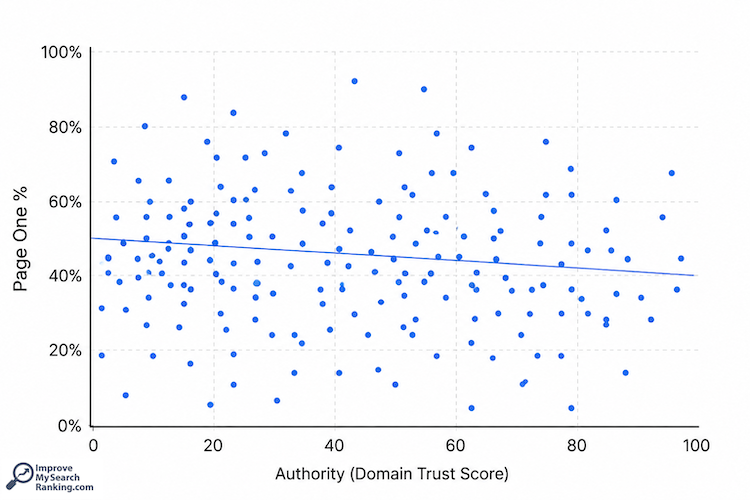
Split the portfolio into quartiles by authority and the myth falls apart:
| Authority quartile | Avg. authority | % on page one |
| Weakest 25% | 15 | 47% |
| Strongest 25% | 62 | 34% |
The weakest sites — roughly four times less “authoritative” — won. The best-performing band of all was the low-authority tier (Domain Trust 16–35), with a median 63% of keywords on page one. Authority wasn’t the lever. Keyword selection was.
Finding 02: Low-authority sites out-rank the directories
This is the headline. Every local business owner hears the same thing: you’ll never beat Checkatrade and Yell — they’re too big. So we measured it. For each campaign we pulled every domain in the client’s tracked top-10 results and compared visibility, head to head.
In local campaigns, our clients beat almost every major directory – on a tiny fraction of the backlink profile. An oven-cleaning client (just 85 referring domains) appeared in 49.7% of its tracked SERPs, out-ranking MyBuilder, Trustatrader, Yell, Bark, Thumbtack and Yelp. The only domain ahead of it on average was Checkatrade.
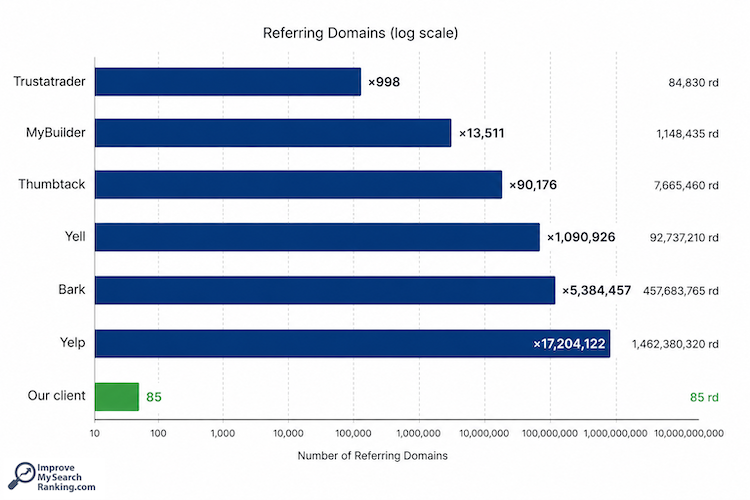
A gardening client (224 referring domains) told the same story: 43.8% visibility, beating Trustatrader, MyBuilder, Yell, Yelp, Angi, Houzz and HomeAdvisor — only Checkatrade ahead.
The reason is relevance, not strength.
A page built specifically for “oven cleaning [town]” — written for that town, about that service, from a legitimately good business – beats a generic directory listing that merely contains the town name in a database.
Google rewards the most specific, most relevant result, and a focused local page is almost always more specific than a directory category page. Authority only decides close fights – and against a hyper-relevant local page, it usually isn’t close.
Finding 03: Who you’re actually competing with
Strip the handful of directories and social platforms out of a typical local SERP and look at what’s left. In the gardening campaign, of roughly 250 competing domains, only about eight were directories or aggregators. The rest — the real competition — were small local landscapers and garden designers, the overwhelming majority carrying fewer than 300 referring domains, many fewer than 50.
That’s the quiet truth of local search: your real competitors aren’t the household-name directories. They’re other small businesses with authority scores as modest as yours. Whoever builds the more relevant, better-scoped and most useful local pages wins — a contest of strategy and execution, not link count.
The playbook: What to do if you run a local business
- Lead with keyword competition, not your authority score.
- A scary national difficulty number says nothing about whether you can own “[your service] [your town].”
- Go granular.
- The smaller and more specific the location, the easier the win — and those searchers are ready to buy.
- Expect to rank in weeks, not years.
- A new site can reach page one across dozens of local terms with no big link-building campaign, if the keywords are low on competition.
- Beat the directories on local intent; ignore them on broad heads.
- You’ll usually out-rank Yell, Trustatrader and MyBuilder on “[service] [town].”. Don’t go after short tail keywords – but why would you as a local business?
- Save link-building for the fights that need it.
- Easy local wins first, authority later — only for the genuinely competitive terms. But it is worthwhile tackling low hanging backlink fruit – like claiming your listing on the major directors and aggregators.
Conclusion
For years, local businesses have been told they can’t compete until they’ve built huge backlink profiles. Our data suggests the opposite. If you target the right keywords and build genuinely relevant local pages, you don’t need to beat the directories on authority. You only need to beat them on relevance. And for the searches that actually generate enquiries, that’s happening every day.
Methodology and caveats
These figures come from tracked-keyword sets our clients and we chose for each campaign, so the study measures how winnable the keywords we target are with a good SEO strategy in place – not an abstract verdict on a domain’s quality..
Domain authority isn’t useless either – it’s a tiebreaker that decides close fights between strong competitors.
Visibility share is a coverage measure across a campaign’s tracked queries on a single snapshot date; directory backlink figures are from SE Ranking’s index at the time of writing and drift over time.
The conclusion holds regardless: across 156 campaigns and 20,000 keywords, authority barely moved the needle — and small, low-authority local sites beat directories with thousands of times their backlink profile, every day, on the searches that bring in customers.
The post I tracked 20,000 keywords. Domain authority barely mattered appeared first on Improve My Search Ranking.
#seotips #seo #digitalmarketing #searchengineoptimization #seoexpert #seoservices #seomarketing #digitalmarketingtips #marketing #seotools #seoagency #seostrategy #contentmarketing #socialmediamarketing #google #digitalmarketingagency #searchenginemarketing #onlinemarketing #socialmedia #onpageseo #website #marketingtips #seotipsandtricks #searchengineoptimisation #searchengine #digitalmarketingstrategy #googleranking #offpageseo #keywords #webdesign


